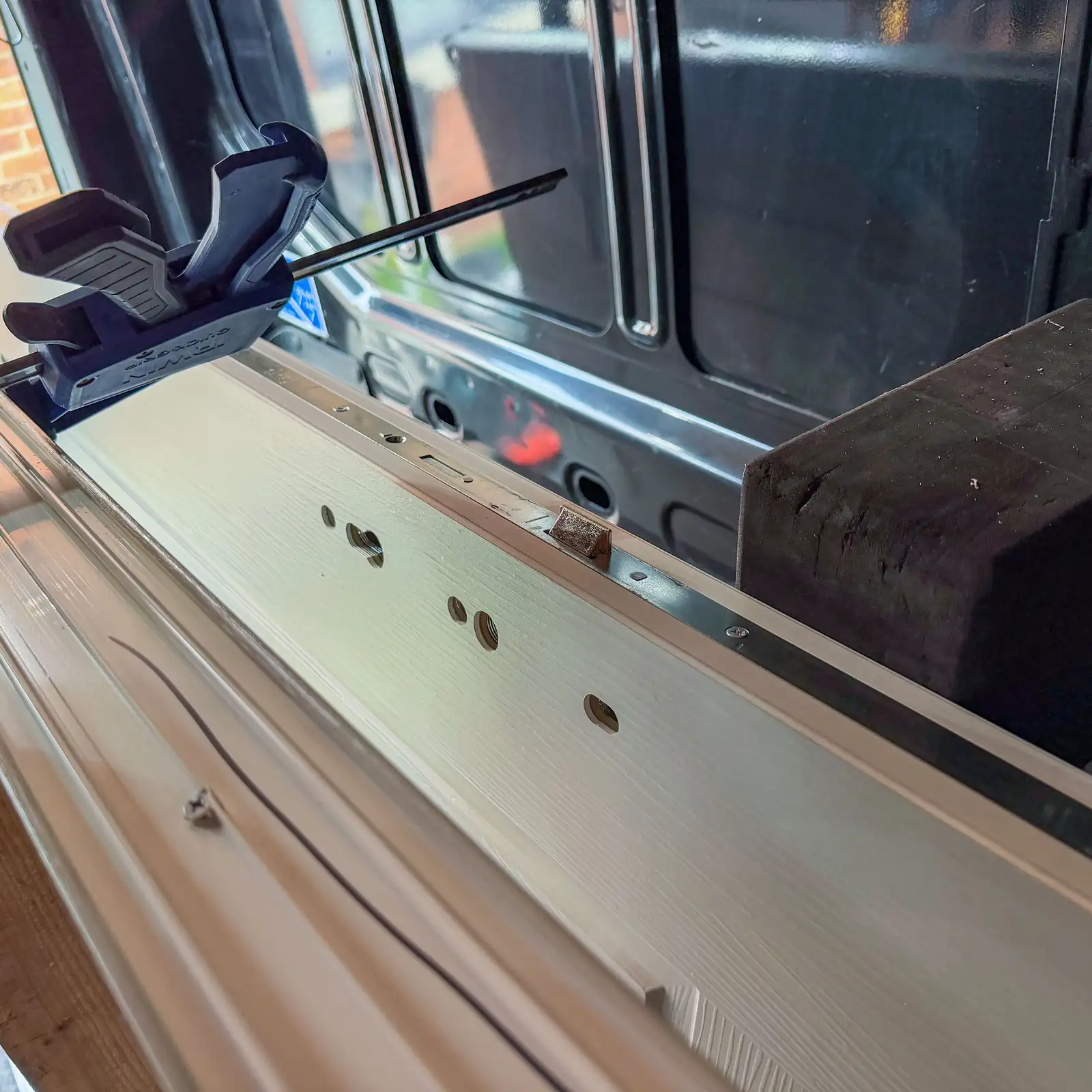
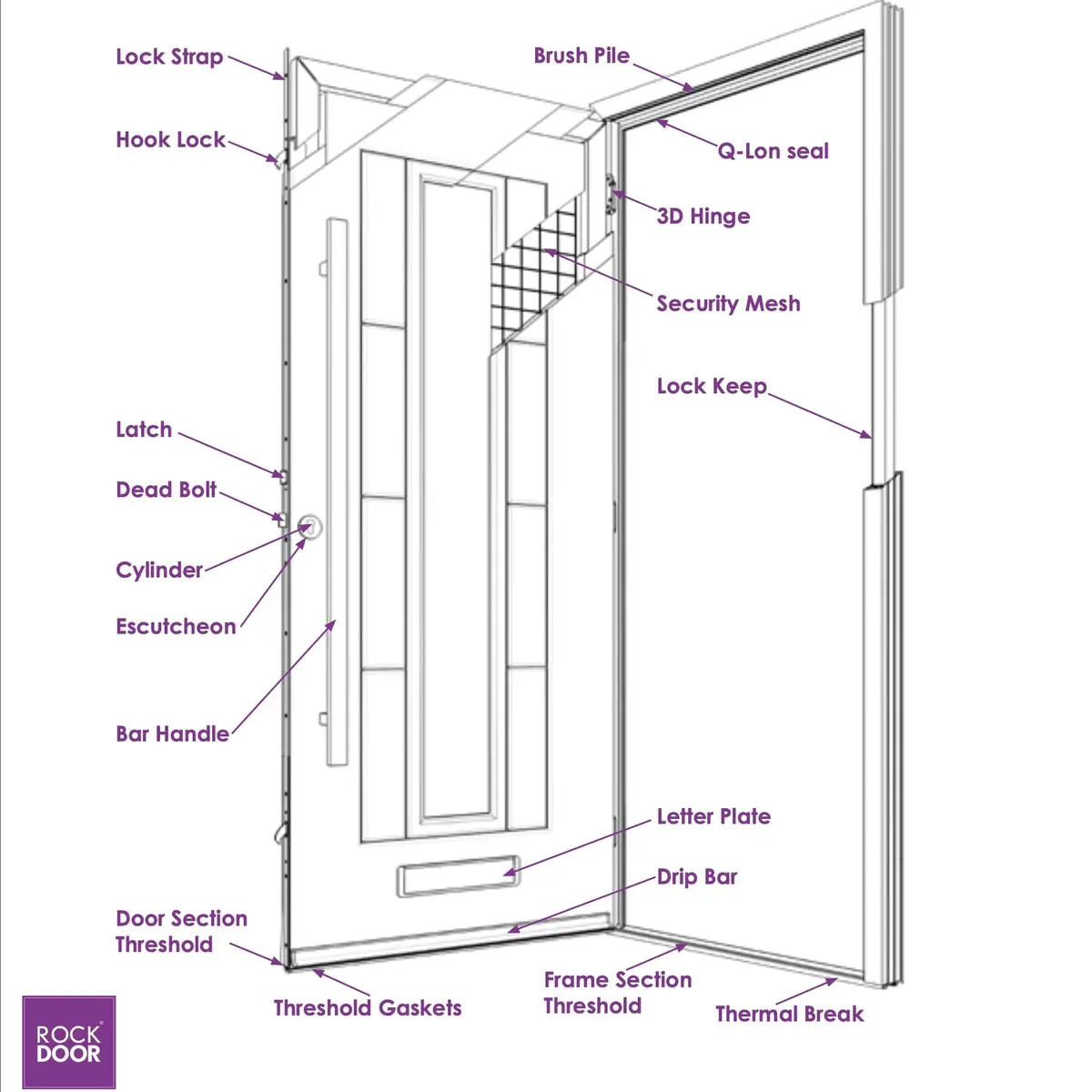
Rockdoor offers 14 colours across four collections — Modern, Classic, Wood and Trending. Every colour uses a foiled uPVC skin that’s vacuum-formed onto the door during manufacturing, giving it the depth and grain of timber without the maintenance. The finish doesn’t fade, flake or peel, and a wipe with soapy water is all it needs to stay looking fresh.
Because you can choose different colours for the inside and outside of your door, that’s 196 possible combinations — letting you match the exterior to your brickwork and the interior to your hallway.
We’ve fitted over 2,000 Rockdoors since 2010 across Derby, Nottingham, Leicester and the wider Midlands, so we’ve seen every colour on every type of property. This guide covers each one in detail — including the RAL codes you’ll need if you’re matching to existing windows, fascias or cladding.
What We’re Fitting Right Now: 2026 Colour Breakdown
Based on our recent installations, here’s roughly how colour choices are splitting across the doors we’re fitting in 2026:
| Colour | Share of Our Installations | Trend |
|---|---|---|
| Agate Grey | ~30% | ↑ Growing fast since 2024 |
| Anthracite Grey | ~15% | ↓ Losing ground to agate grey |
| White | ~14% | → Steady (mainly back doors) |
| Black | ~10% | → Steady |
| Irish Oak | ~7% | → Steady |
| Slate Grey | ~5% | → Steady |
| Cream | ~5% | → Niche |
| Pebble Grey | ~2% | ↑ New — still building momentum |
| Chartwell Green | ~2% | → Niche |
| Sapphire Blue | ~2% | ↓ Declining |
| Ruby Red | ~2% | ↓ Declining |
| Emerald Green | ~2% | ↓ Declining |
| Light Oak | ~2% | ↓ Declining |
| Rosewood | ~2% | ↓ Declining |
The grey shades now account for over half of everything we fit. That’s a dramatic shift from when we started in 2010, when black, sapphire blue and ruby red were among the most popular choices and the grey options didn’t exist yet in the Rockdoor range.
The greys started gaining serious traction around 2014, led by anthracite grey. For nearly a decade, anthracite was the undisputed favourite — both for us and across the industry. Then Rockdoor launched agate grey in July 2020 (other brands had offered similar shades under names like Painswick for slightly longer), and from 2024 onwards agate grey has been outselling anthracite in our order book. It’s a shift we don’t see reversing any time soon.
At the other end, colours like sapphire blue, ruby red, emerald green, light oak and rosewood are gradually declining. We still fit them — particularly rosewood where customers are matching existing windows — but they’re a small and shrinking proportion of our work.
Quick Reference: All 14 Rockdoor Colours & RAL Codes
Before we go into detail on each colour, here’s the full list with RAL codes and frame availability at a glance:
| Colour | RAL Code | Collection | Matching Frame (External) | Matching Frame (Internal) |
|---|---|---|---|---|
| Agate Grey | RAL 7038 | Modern | ✓ | ✓ |
| Anthracite Grey | RAL 7016 | Modern | ✓ | ✓ |
| Slate Grey | RAL 7015 | Modern | ✓ | ✓ |
| Pebble Grey | RAL 7032 | Modern | ✓ | ✗ * |
| White | RAL 9010 | Classic | ✓ | ✓ |
| Cream | RAL 9001 | Classic | ✓ | ✓ |
| Black | RAL 8022 | Classic | ✓ | ✓ |
| Chartwell Green | ~RAL 6021 | Classic | ✓ | ✓ |
| Sapphire Blue | RAL 5011 | Classic | ✗ | ✗ |
| Ruby Red | RAL 3011 | Classic | ✗ | ✗ |
| Emerald Green | RAL 6009 | Classic | ✗ | ✗ |
| Irish Oak | ~RAL 1011 | Wood | ✓ | ✓ |
| Light Oak | ~RAL 8033 | Wood | ✓ | ✓ |
| Rosewood | ~RAL 8017 | Wood | ✓ | ✓ |
* Pebble Grey is the only colour where a matching internal frame face isn’t available — the external face is pebble grey but the internal face is always white.
Sapphire Blue, Ruby Red and Emerald Green are supplied with a white frame on both faces — no coloured frame option is available.
For all other colours, if you choose a coloured frame, the internal face can be either the same colour or white. See the Frame Colour Options section below for full details.
The tilde (~) indicates a closest match rather than an exact RAL code — the woodgrain finishes are identified by name rather than a precise RAL number.
A quick note on RAL codes: these are a standardised European colour coding system used across the construction industry. They’re particularly useful when you need your new front door to match existing windows, garage doors, fascias or cladding. If your window supplier says your frames are RAL 7016, you know Anthracite Grey is the exact match. We explain this in more detail in our Rockdoor technical specification guide.
The Modern Collection
The four grey shades in Rockdoor’s Modern collection are by far the most popular colours we fit. Between them, they account for well over half of all our installations.
Agate Grey (RAL 7038) — Our Most Popular Colour in 2026
Agate grey has overtaken anthracite grey as our single most popular colour in 2026. Around 30% of all the doors we’re fitting right now are agate grey — and the proportion is growing.
It’s a soft, mid-toned grey that’s lighter and warmer than anthracite. Where anthracite makes a bold statement, agate grey sits more quietly against your brickwork without disappearing into it. It works particularly well with the buff and red brick tones that are common across Derby, Nottingham and the East Midlands, and it pairs beautifully with white window frames — which is still the most common window colour in the region.
From a practical standpoint, agate grey is also a sensible choice for south-facing doors. Darker colours absorb more heat in direct sunlight, which can cause minor thermal movement in any composite door. Agate grey is light enough to minimise this while still looking distinctly contemporary. If your door gets a lot of afternoon sun, this is worth considering — and it’s something we always discuss during the survey.
We’ve fitted agate grey across a huge range of styles, but it looks especially good on the Rockdoor Vermont with Haze glass and on the Rockdoor Newark on period properties.
Best suited to: Modern new builds, buff or red brick, properties with white windows. Works well on both traditional and contemporary door styles.
Frame options: Matching agate grey frame available, or white frame for contrast.
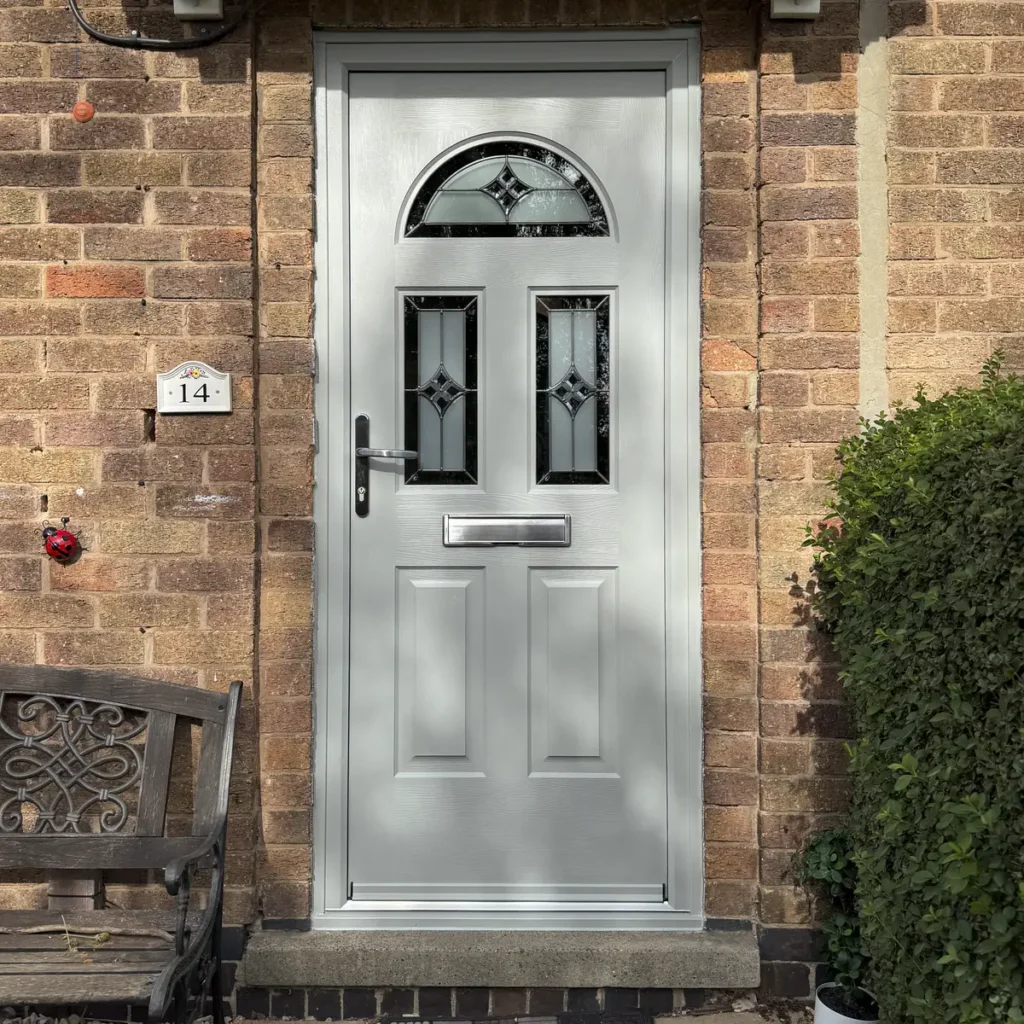


Anthracite Grey (RAL 7016) — The Industry Standard
Anthracite grey was the UK’s most popular composite door colour for years, and it’s still one of our biggest sellers. It’s a deep, dark charcoal grey — much darker than agate — and it makes a strong architectural statement. If you’ve driven around any new housing estate built in the last decade, you’ll have seen anthracite grey everywhere: front doors, window frames, fascias, garage doors, even guttering.
That ubiquity is both its strength and its limitation. It looks exceptional — particularly when the door, frame and windows all match in RAL 7016 for a fully coordinated contemporary look. But because it’s so widespread, some homeowners are now choosing agate or slate grey to stand out a little from the neighbours.
Anthracite grey absorbs the most heat of the four modern greys, so for south-facing or south-west-facing doors, it’s worth being aware of this. Rockdoor’s 360° aluminium inner frame and 3mm no-bow guarantee mean thermal movement is extremely well controlled, but if you want to be cautious, lighter greys are the safer bet for sun-exposed entrances.
When we fit an anthracite grey door with a matching anthracite frame alongside matching grey windows — which we’re seeing more and more across Derby and Nottingham — the overall effect is striking. It’s one of those colour combinations that genuinely transforms the front of a house.
Best suited to: Contemporary properties, new builds, homes where you want the door to match anthracite windows and fascias. Creates the most dramatic kerb appeal of the greys.
Frame options: Matching anthracite grey frame available, or white for contrast.
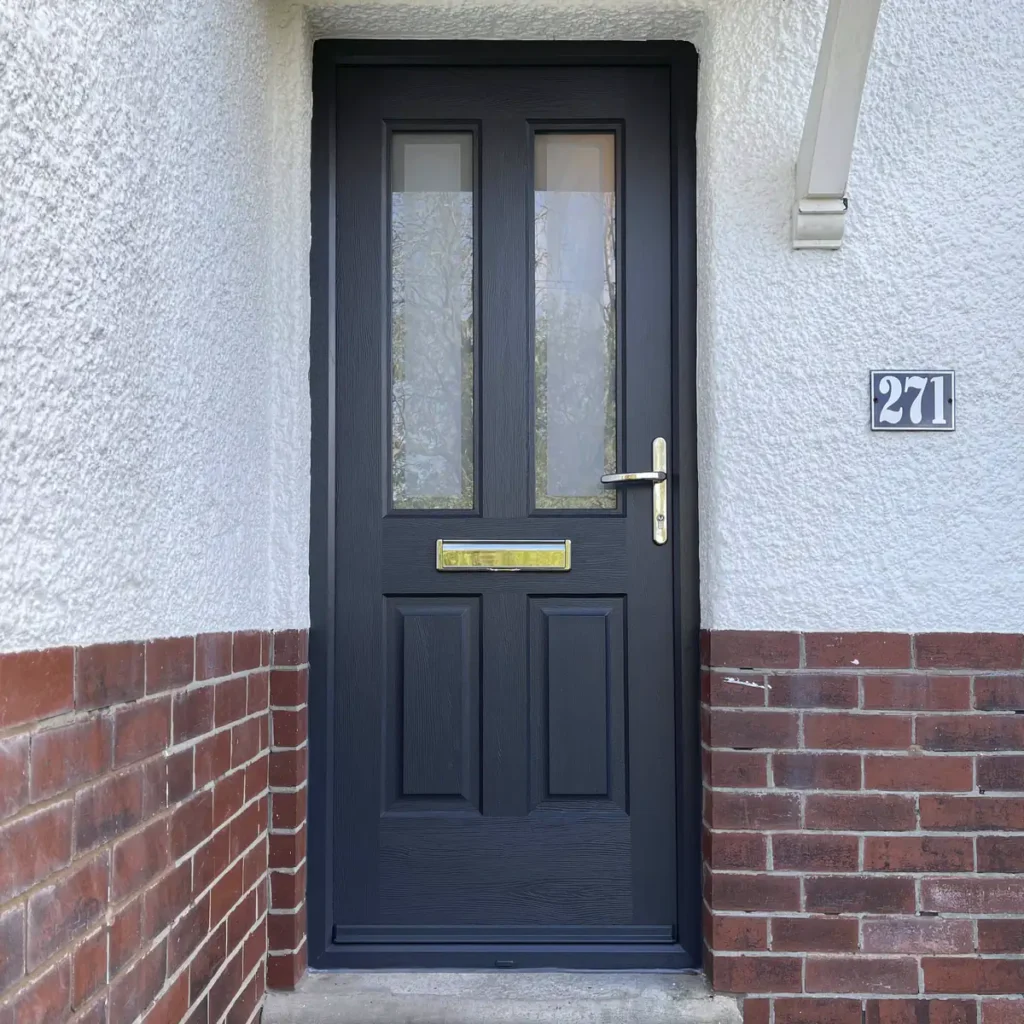
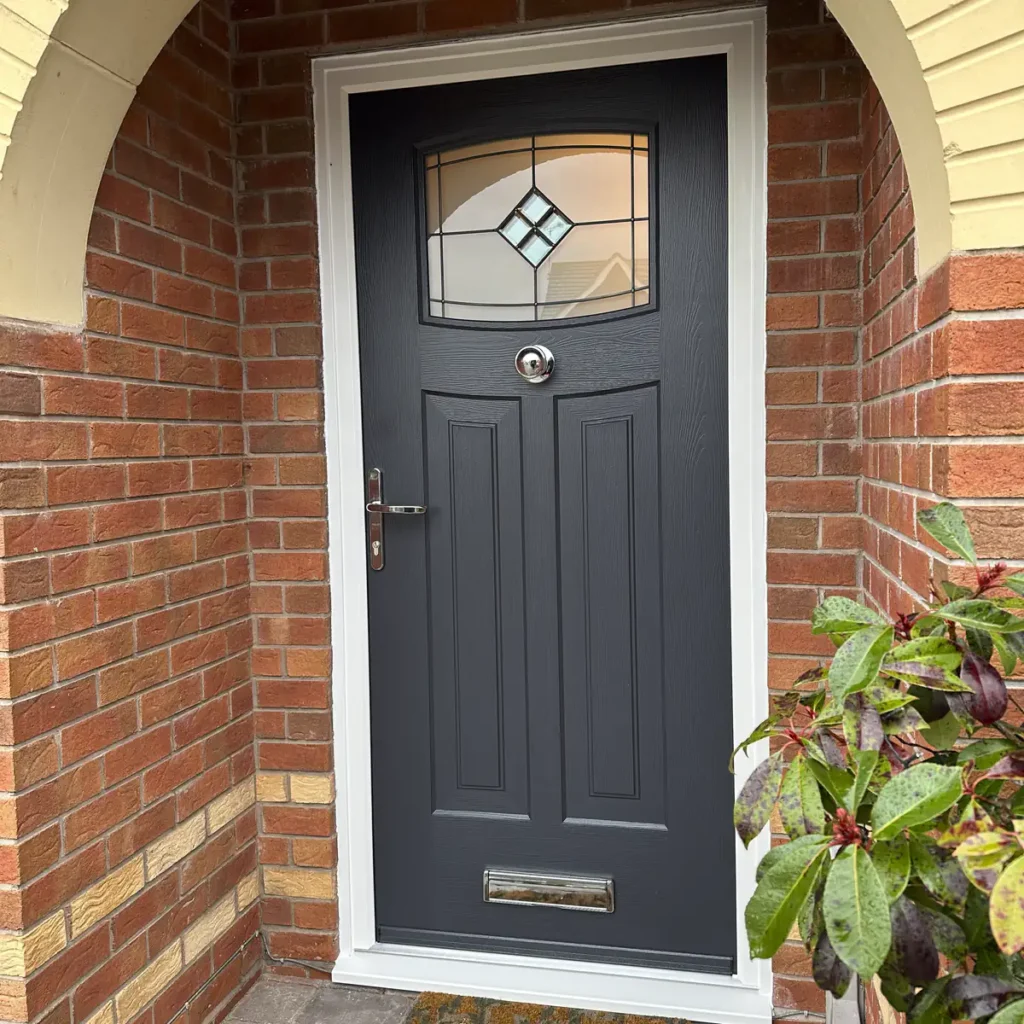


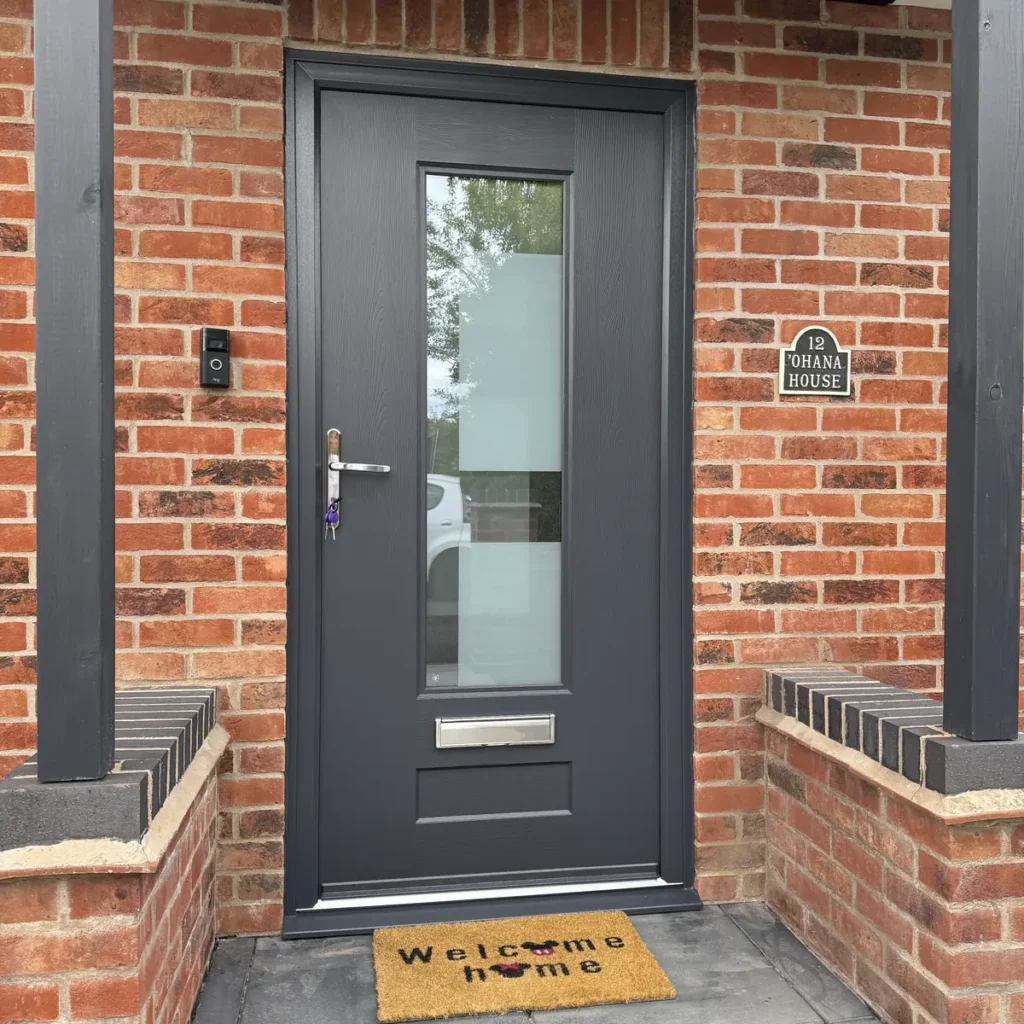
Slate Grey (RAL 7015) — The Understated Middle Ground
Slate grey sits between anthracite and agate in terms of depth — darker than agate but noticeably lighter than anthracite. It has a slightly blue-ish undertone that gives it a distinctive character compared to the other greys.
It’s less common than both anthracite and agate, which is actually part of its appeal. Customers who choose slate grey tend to want something that reads as contemporary and sophisticated without being as bold as anthracite or as soft as agate. It pairs well with natural stone, render, and grey brick.
We don’t fit as many slate grey doors as anthracite or agate, but the ones we do fit always look excellent. It’s a colour that rewards careful matching — if your property has cool-toned brickwork or grey render, it can be the perfect complement.
Best suited to: Stone-built properties, grey render, cool-toned brickwork. Good for homeowners who want a distinctive grey without going as dark as anthracite.
Frame options: Matching slate grey frame available, or white.


Pebble Grey (RAL 7032) — The Newest Addition
Pebble grey is Rockdoor’s newest colour, added to the range in 2024 alongside the launch of the Hudson door style. It’s a warm, mid-toned grey with a slight taupe quality — warmer than agate grey and with a softer, more natural feel.
Rockdoor describe it as sitting between their other greys and the warmer tones of the woodgrain finishes. In person, it has an almost stone-like quality that works well with natural materials — think Cotswold stone, cream render, or warm red brick.
It’s still early days for pebble grey (we’ve only fitted a handful so far), but initial reactions from customers have been very positive. If you’ve seen agate grey and felt it was still a touch too cool for your property, pebble grey is worth considering. It’s available across all Rockdoor styles.
One thing to note: the matching outerframe in pebble grey is only available on the large face (the external side). The internal frame face will be white. This is specific to pebble grey — all the other colours that offer a matching frame provide it on both faces.
Best suited to: Warm-toned brickwork, natural stone, cream render. Homes where agate grey feels too cool but a woodgrain finish isn’t right.
Frame options: Matching pebble grey frame available (large face only), or white.
The Classic Collection
White (RAL 9010) — Clean, Bright and Timeless
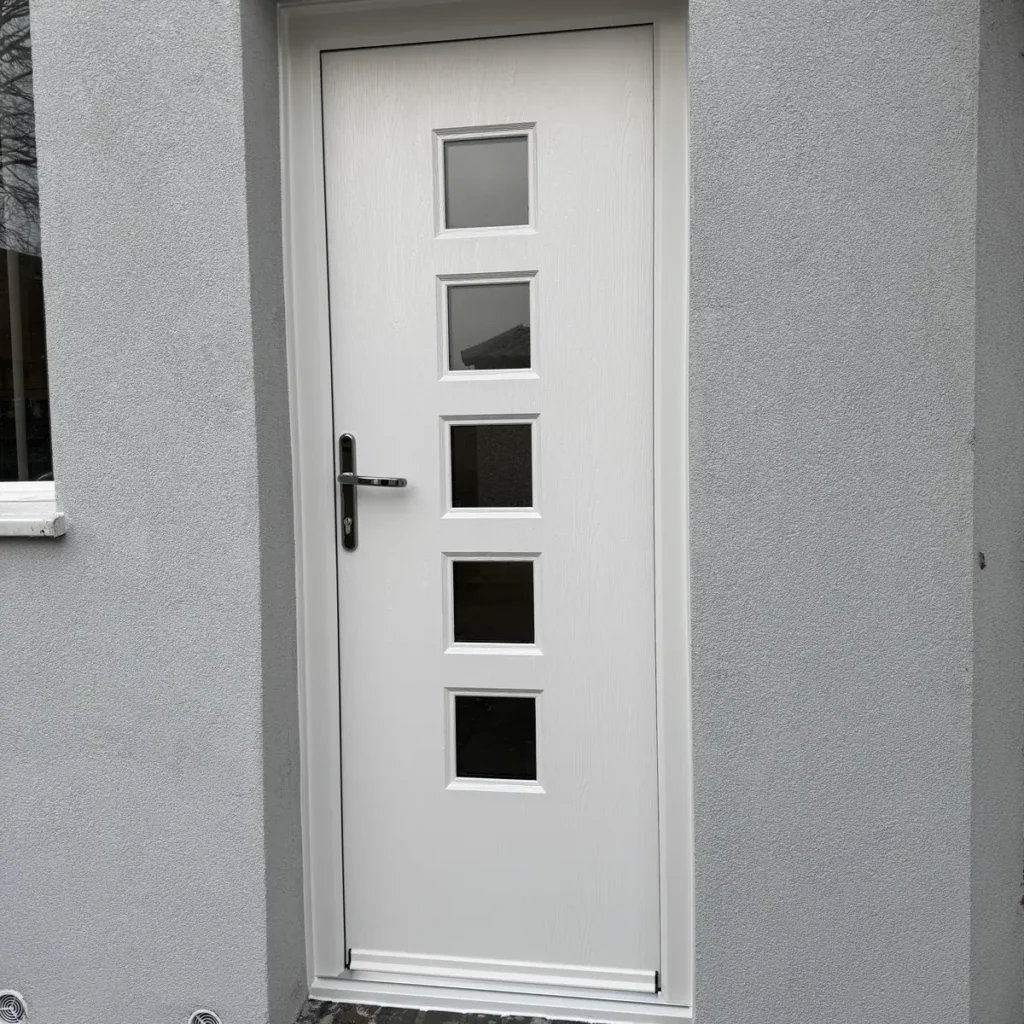
White remains one of the most popular Rockdoor colours — particularly for back doors, French doors and stable doors where it matches existing white window frames. For front doors, it’s a classic choice that suits virtually every property style, from Victorian terraces to modern new builds.
White is also the base colour for Rockdoor’s pricing — meaning there’s no colour upgrade charge. Every other colour adds approximately £70 to the cost of the door. It’s a small amount in the context of the overall price (most customers spend between £1,900 and £2,100 on a single Rockdoor), but worth knowing if budget is tight.
The white finish uses the same foiled uPVC skin as every other colour, so it has the same subtle woodgrain texture. It’s not a flat, painted white — it has depth and warmth to it.
Best suited to: Any property. Essential for matching white windows. The default choice for back doors and French doors. Best value option with no colour upgrade charge.
Frame options: Matching white frame (standard).




Cream (RAL 9001)
Cream is a soft, warm off-white that’s gentler on the eye than pure white. It suits older properties particularly well — especially homes with cream or buff-coloured render, or stone-built properties where pure white would look too stark.
It’s not a colour we fit often (grey shades dominate our orders), but when it’s right for the property, it’s absolutely right. Cream looks especially good on the Rockdoor English Cottage and Rockdoor Jacobean styles.
Best suited to: Period properties, cream render, static homes, properties where white is too harsh.
Frame options: Matching cream frame available.


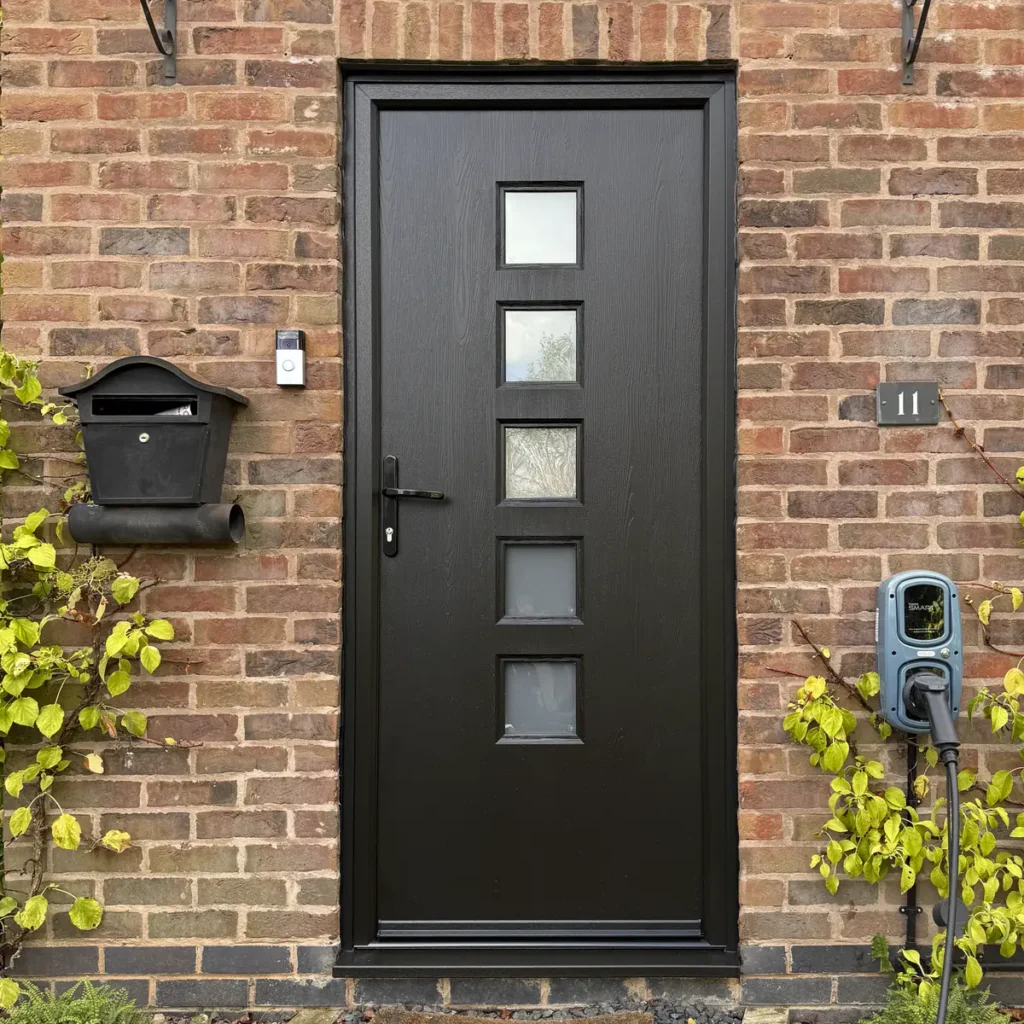
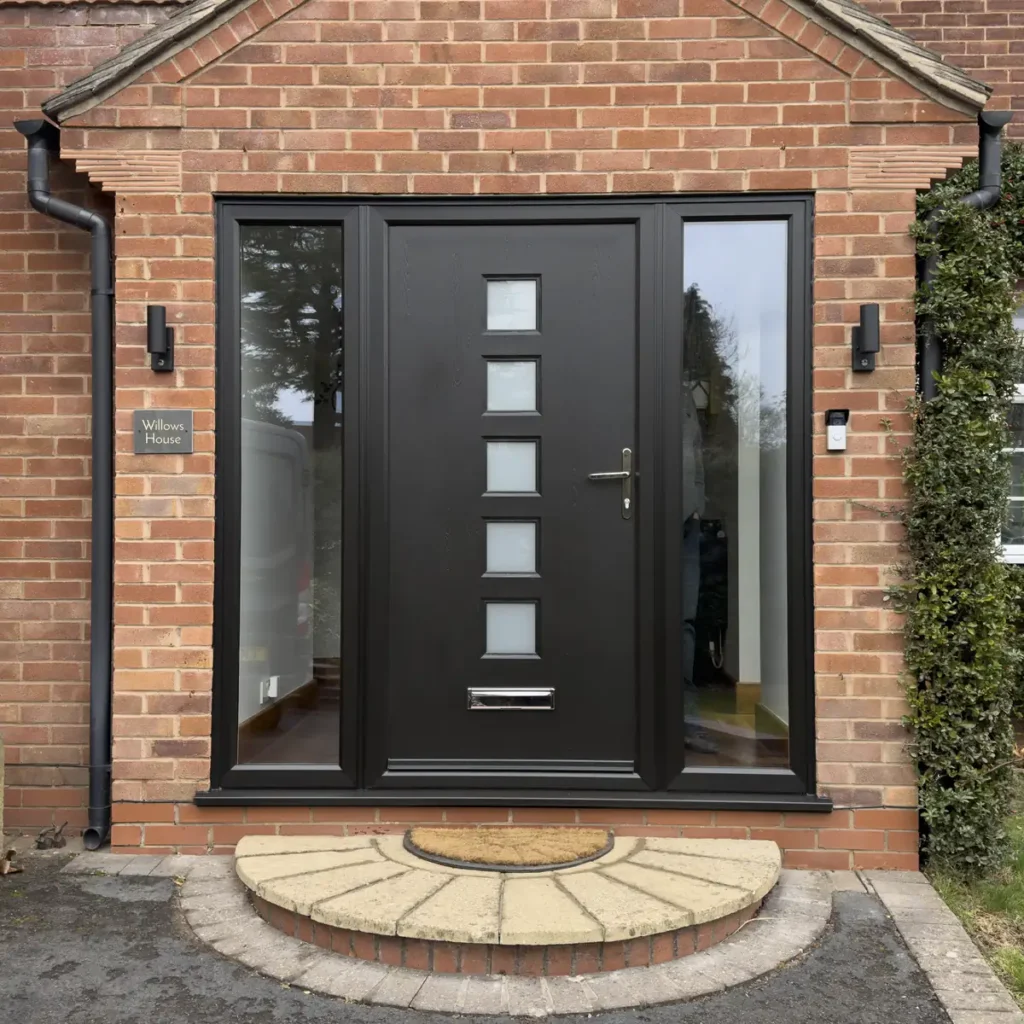
Black (RAL 8022)
Rockdoor’s black is technically classified as RAL 8022 (black brown) rather than a pure jet black. In practice, it reads as black — the brown undertone is very subtle and mainly noticeable in direct sunlight, where it appears fractionally warmer than a pure black would.
Black front doors have a long heritage in British architecture, and a black Rockdoor on a period property with white windows and a brass letterbox is a combination that never goes out of style. It’s also increasingly popular on contemporary properties as an alternative to anthracite grey for homeowners who want maximum contrast.
Like anthracite grey, black absorbs significant heat in direct sunlight. For south-facing installations, this is something to be aware of — though Rockdoor’s construction handles it well.
Best suited to: Victorian terraces, Georgian townhouses, period conversions. Also works on bold contemporary properties. Pairs well with both brass and chrome hardware.
Frame options: Matching black frame available, or white for a traditional look.



Chartwell Green (~RAL 6021)
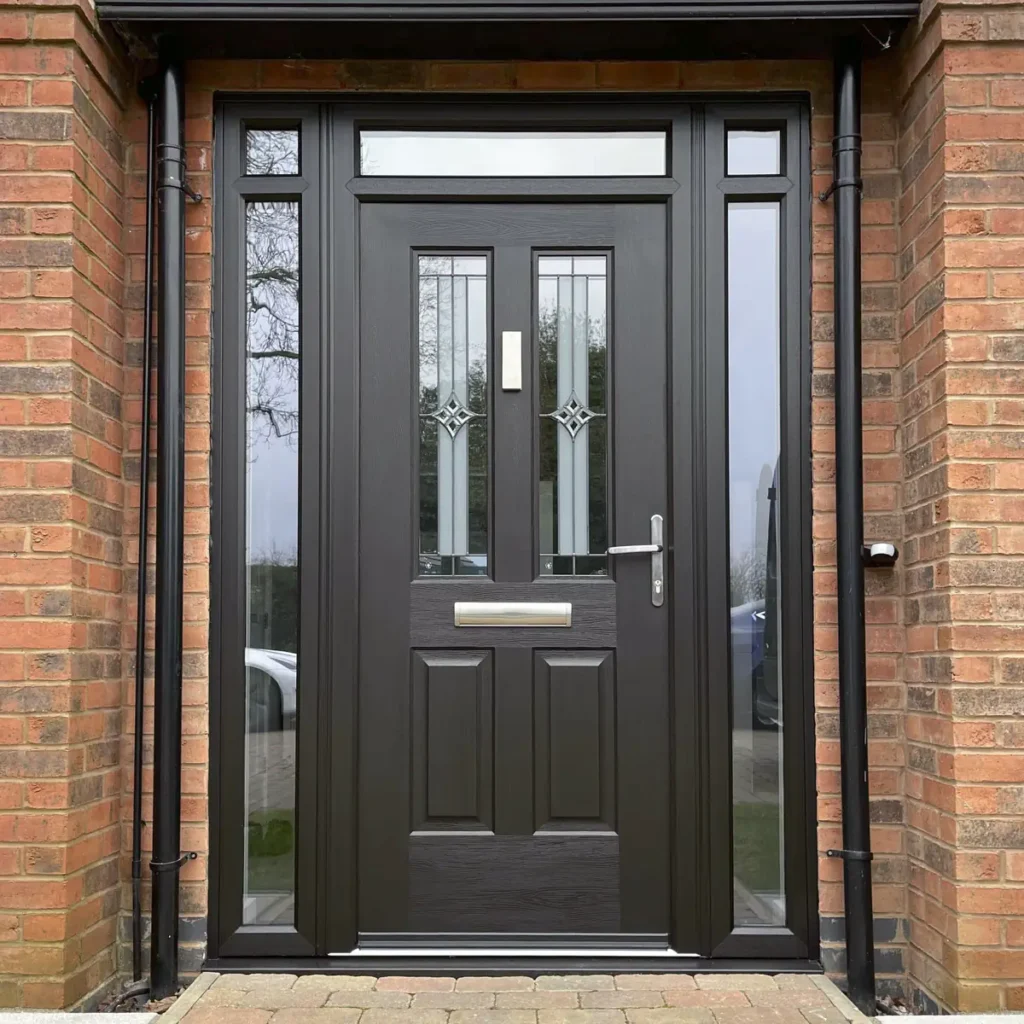
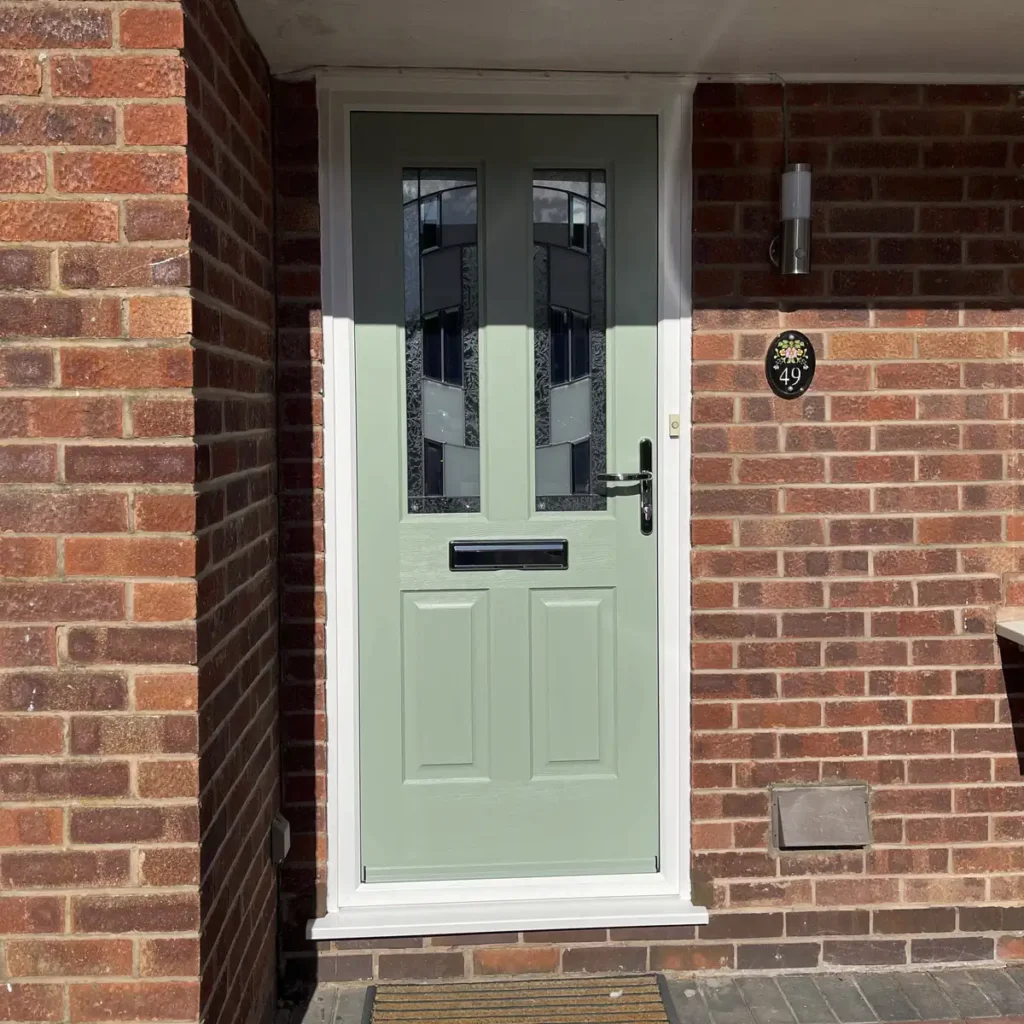
Chartwell green is a soft, sage-like green named after Winston Churchill’s country home. It’s one of those colours that divides opinion — people either love it or don’t consider it — but on the right property, it looks absolutely stunning.
It works best on stone-built properties, period cottages, and rural homes where darker or more urban colours would feel out of place. It’s a popular choice in more rural parts of our coverage area, particularly around Breedon-on-the-Hill, Ashby-de-la-Zouch and the villages between Derby and Burton upon Trent.
The RAL code listed (~6021) is an approximate match rather than an exact one, so if you’re trying to match Chartwell green to existing paintwork or accessories, ordering a swatch or seeing it in person is advisable.
Best suited to: Cottages, stone-built properties, rural homes, period properties with character. Particularly popular in rural Derbyshire and Leicestershire.
Frame options: Matching Chartwell green frame available, or white.


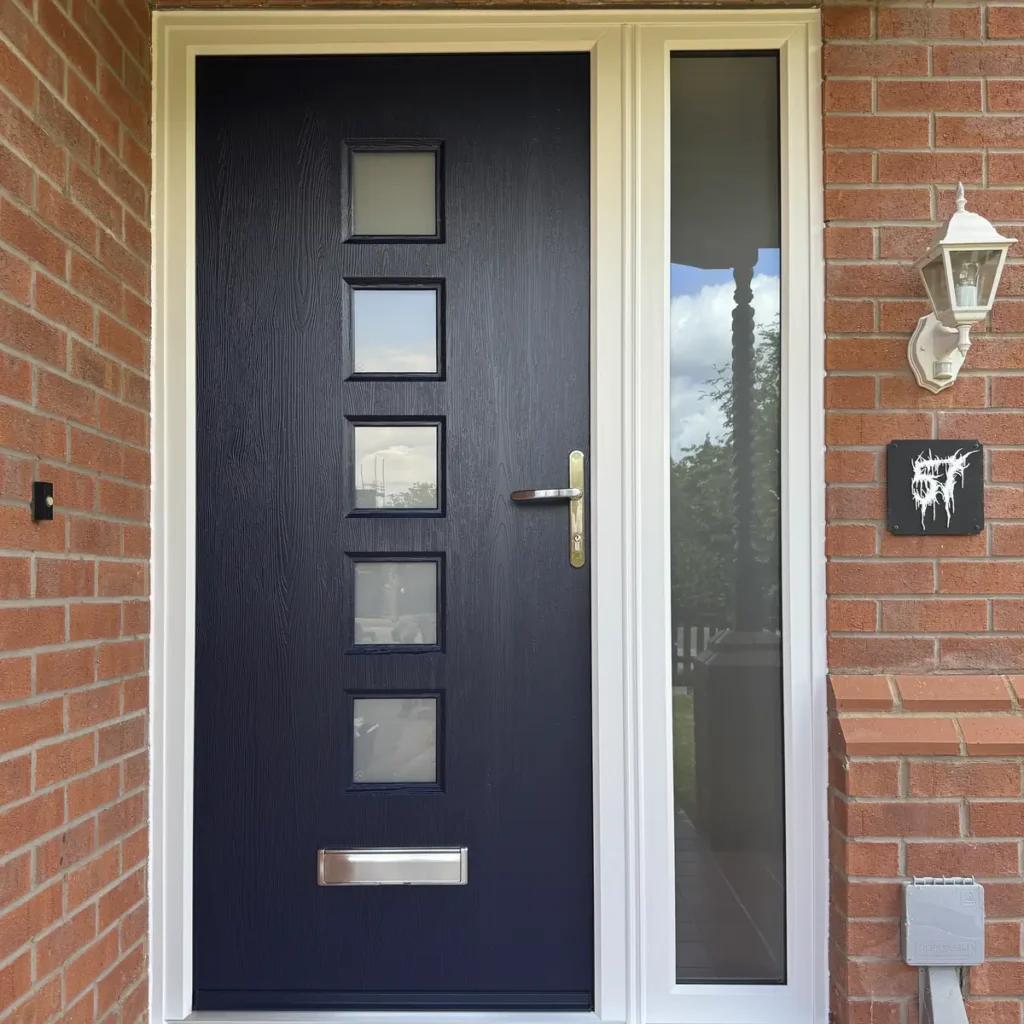
Sapphire Blue (RAL 5011)
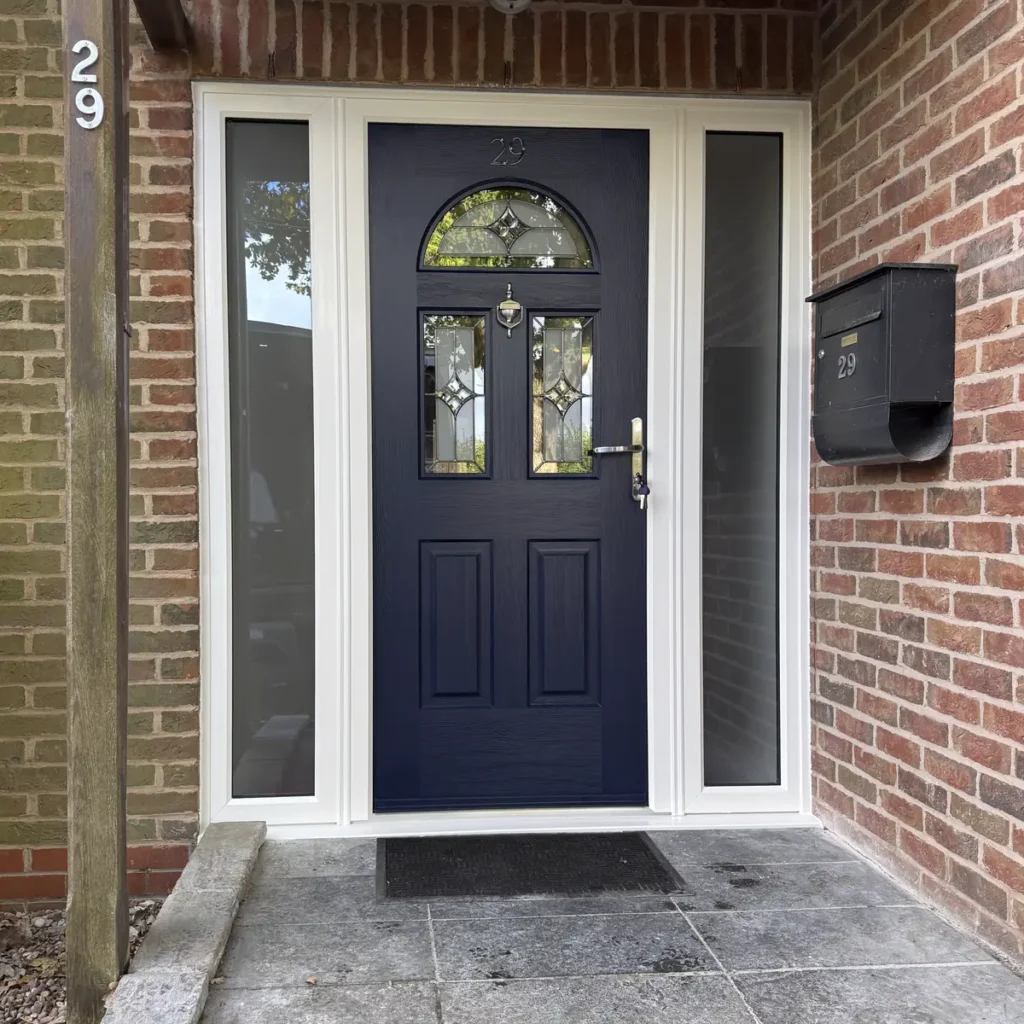
Sapphire blue is a deep, rich navy — far removed from a bright or royal blue. It has a classic, refined quality that works well on traditional properties and Victorian-era homes. Think of it as the front door equivalent of a navy suit: it never looks out of place and always looks smart.
One important thing to note: sapphire blue is one of three colours where a matching coloured frame is not available. Your frame will be white. For many properties this actually works well — the white frame creates a clean border around the deep blue door — but if you specifically want a fully colour-matched entrance, this limits your options.
Best suited to: Victorian and Edwardian properties, traditional terraces, homes with white windows and a classic aesthetic.
Frame options: White frame only (no matching blue frame available).




Ruby Red (RAL 3011)
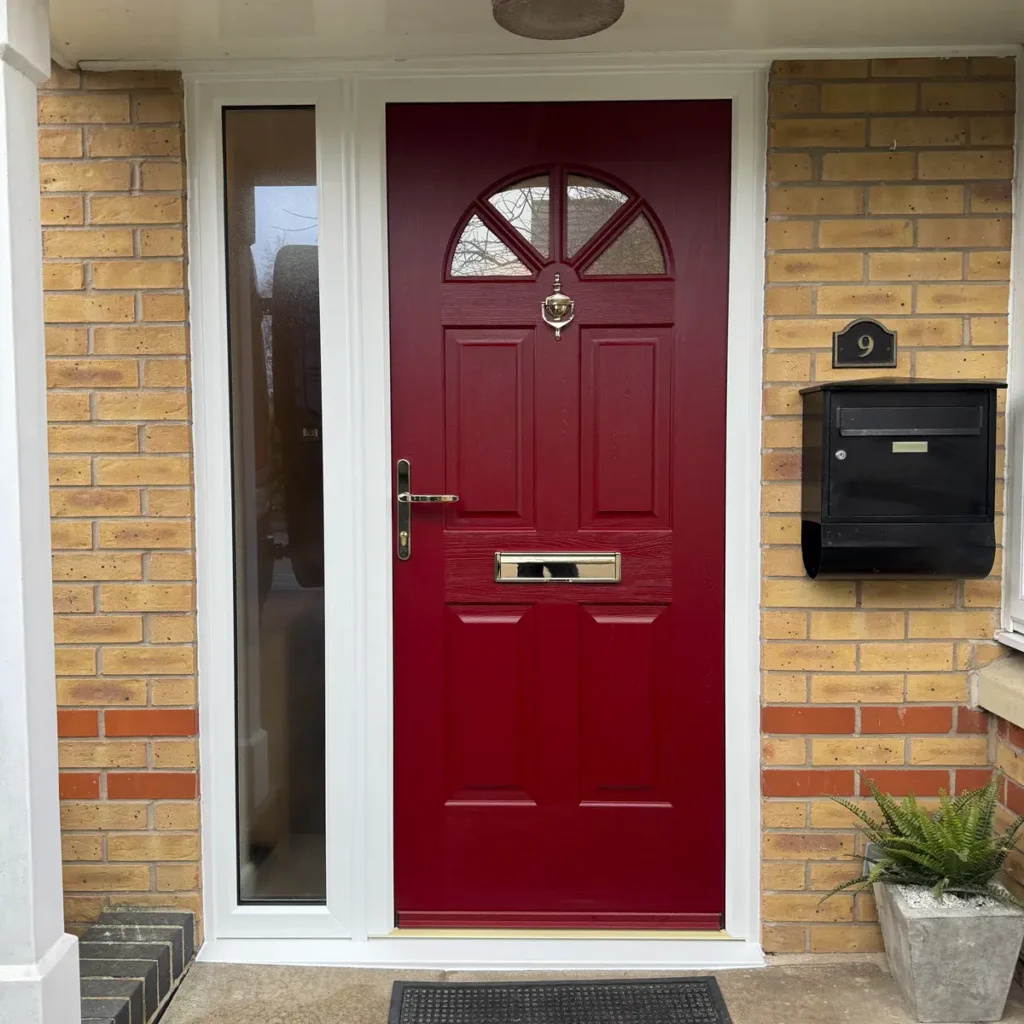
Ruby red is a deep, heritage red — closer to burgundy or maroon than a bright pillar-box red. It’s a classic British front door colour with real kerb appeal, and the contrast against a white frame is a combination that’s worked for decades.
This is one colour where we always manage customer expectations carefully. We regularly get asked for a “brighter red” or “post box red” — but Rockdoor only offers one red, and it’s ruby red (RAL 3011). The interesting thing is that the colour changes dramatically depending on the light. In direct sunlight, ruby red is extremely vibrant — genuinely eye-catching. But in shade or on overcast days, it looks much deeper and darker. Both versions look great, but if you’re expecting a bright red all the time, you need to see it in different lighting conditions before committing. We can show you samples during the survey so there are no surprises.
Like sapphire blue, ruby red is only available with a white outerframe. No matching red frame is offered.
Red front doors are often associated with good luck in several cultures, and they’ve been a staple of British homes for centuries. On Victorian terraces in particular — and there are plenty across Derby and Nottingham — a ruby red Rockdoor Jacobean with diamond leaded glass and brass hardware is an absolute showstopper.




Emerald Green (RAL 6009)
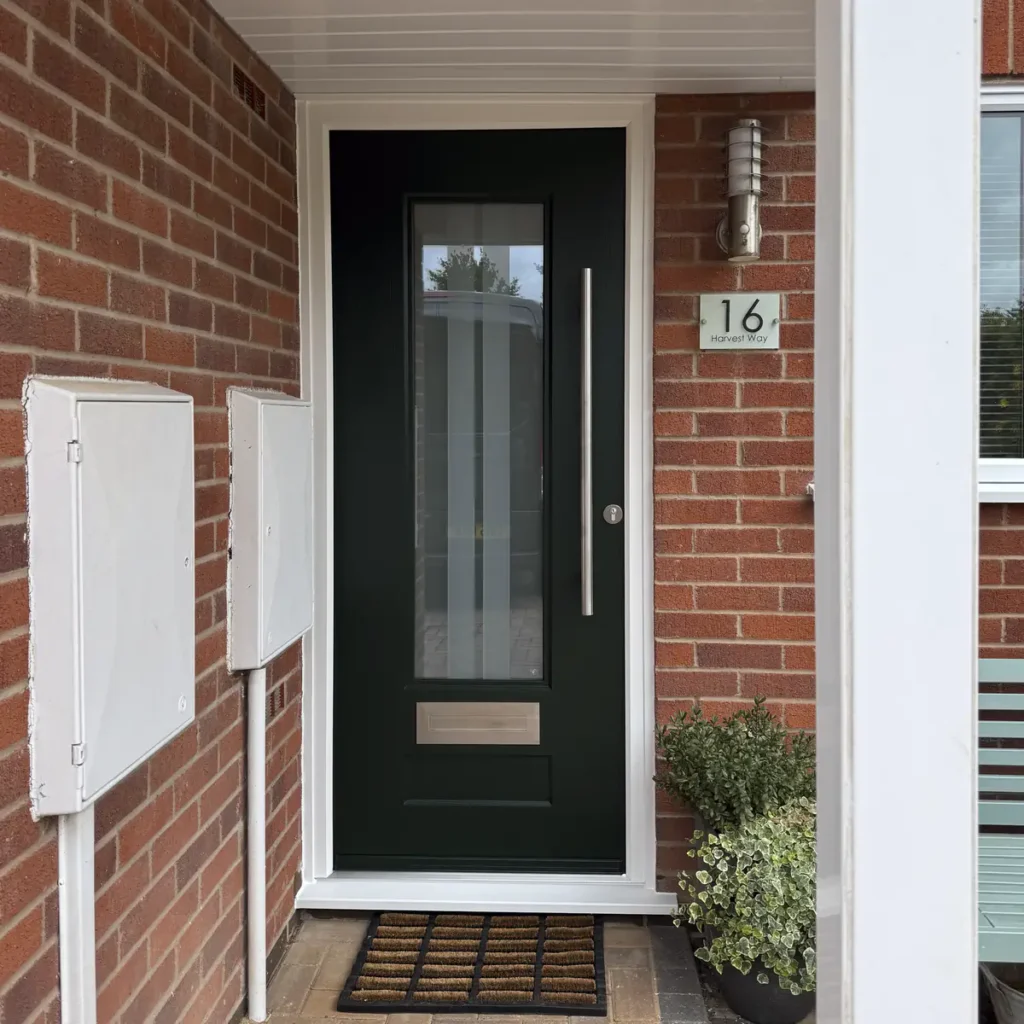
Emerald green is the darkest green in the Rockdoor range — a deep, rich racing green that’s significantly darker and more formal than Chartwell green. It suits grand entrances, Victorian properties and traditional homes where you want the door to feel substantial and classic without resorting to black.
Emerald green is the third colour with no matching frame option — you’ll have a white frame only. As with the other white-frame-only colours, this can actually enhance the look by framing the deep green against a crisp white border.
We don’t fit many emerald green doors, but when we do, they tend to be on larger, detached period properties where the deeper colour suits the scale of the entrance.
Best suited to: Detached period properties, larger homes with traditional character. Works well with chrome or satin hardware.
Frame options: White frame only (no matching green frame available).




The Wood Collection
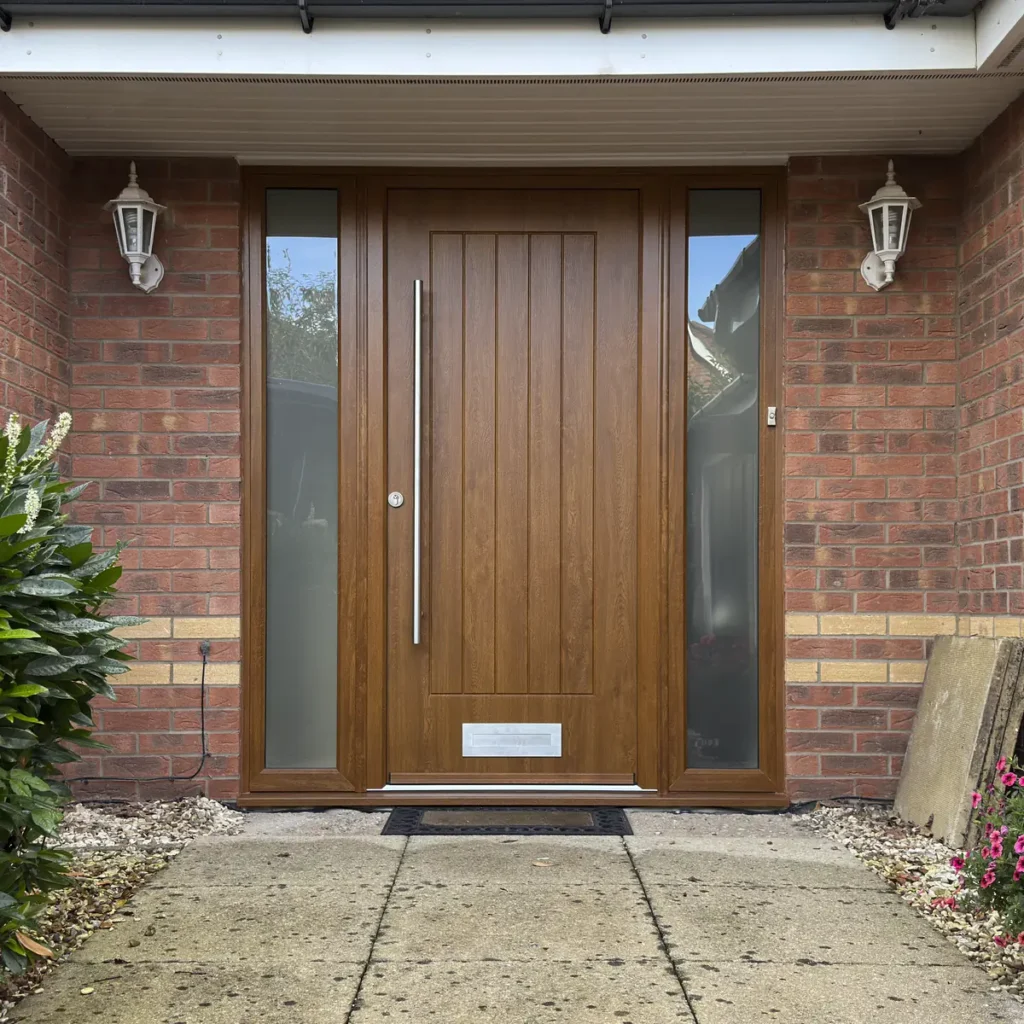
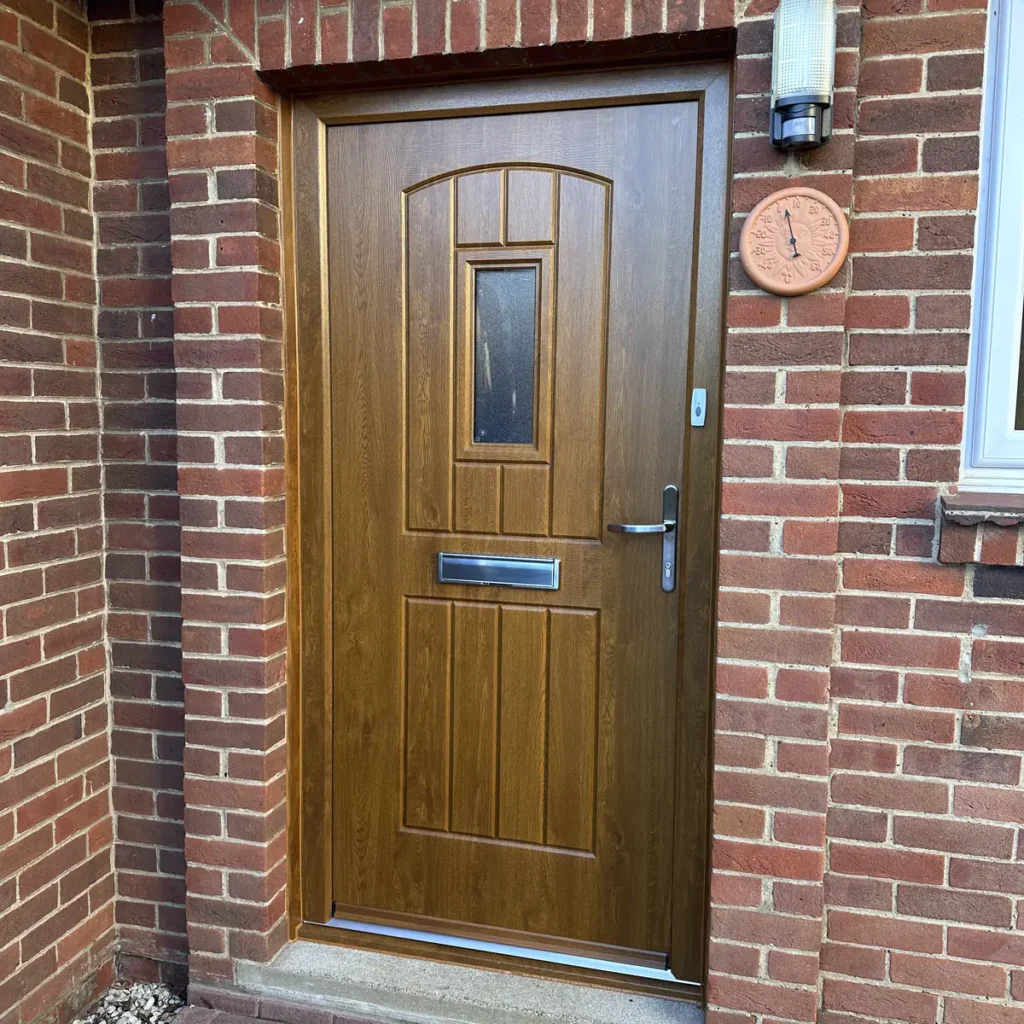
Irish Oak (~RAL 1011)
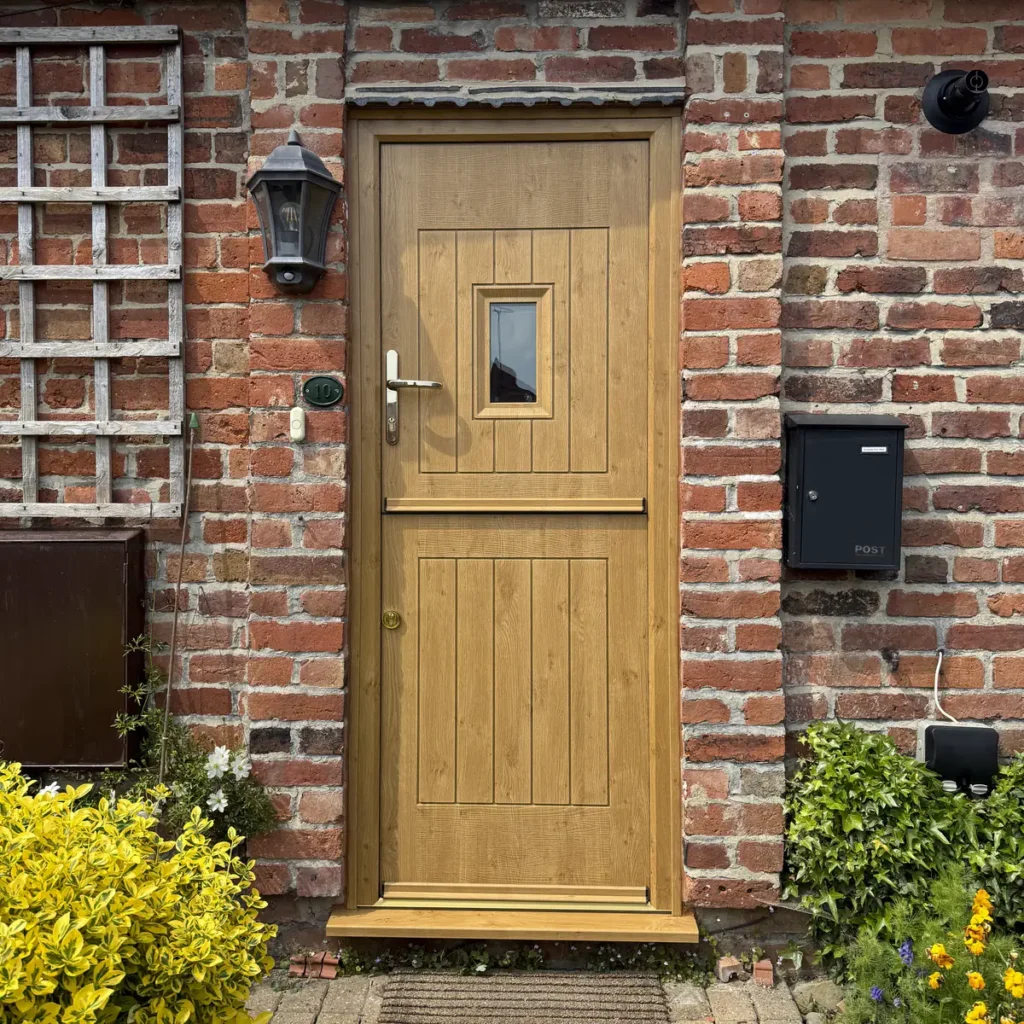
Irish oak is the richer, darker of the two oak woodgrain finishes. It has a warm, deep tone that convincingly mimics natural timber — visitors often assume it’s a real wood door until they touch it.
Irish oak is one of those colours that just looks excellent on every house, in every lighting condition. Unlike some colours that shift dramatically between sun and shade, Irish oak maintains its warm, natural character throughout the day. It’s consistently popular with customers who want the look of timber without the maintenance headaches. Real wood doors need sanding, staining and repainting every few years; an Irish oak Rockdoor needs a wipe with soapy water. After 15 years of fitting these, we can say with confidence that the finish holds up remarkably well.
A lot of customers choose Irish oak specifically for the internal face of their door to match internal oak doors, skirting or staircase woodwork inside. With a dual-colour setup, you can have a contemporary grey or black exterior and a warm oak interior that ties into your hallway.
It looks particularly effective paired with an anthracite grey frame — a combination that creates a striking modern-traditional contrast. Irish oak door with anthracite frame and matching anthracite windows is one of the combinations that regularly makes people stop and look.
Best suited to: Properties where a natural wood aesthetic is desired. Cottages, barn conversions, period homes and traditional new builds. Particularly good with anthracite grey frames for a contemporary twist.
Frame options: Matching Irish oak frame available (both faces), or white, or any of the other 10 matching frame colours — anthracite grey is a particularly popular combination.



Light Oak (~RAL 8033)
Light oak is a paler, honey-toned woodgrain — lighter and more golden than Irish oak. It suits properties with lighter brickwork or stone and creates a warm, welcoming entrance.
It’s less popular than Irish oak in our experience (Irish oak outsells it by a significant margin), but it’s the right choice for homes where a darker woodgrain would feel too heavy. Static homes and park homes often suit light oak well, as do properties with cream or buff exteriors.
Best suited to: Lighter-coloured properties, static/park homes, bungalows, homes with cream or buff brickwork.
Frame options: Matching light oak frame available, or white.



Rosewood (~RAL 8017)
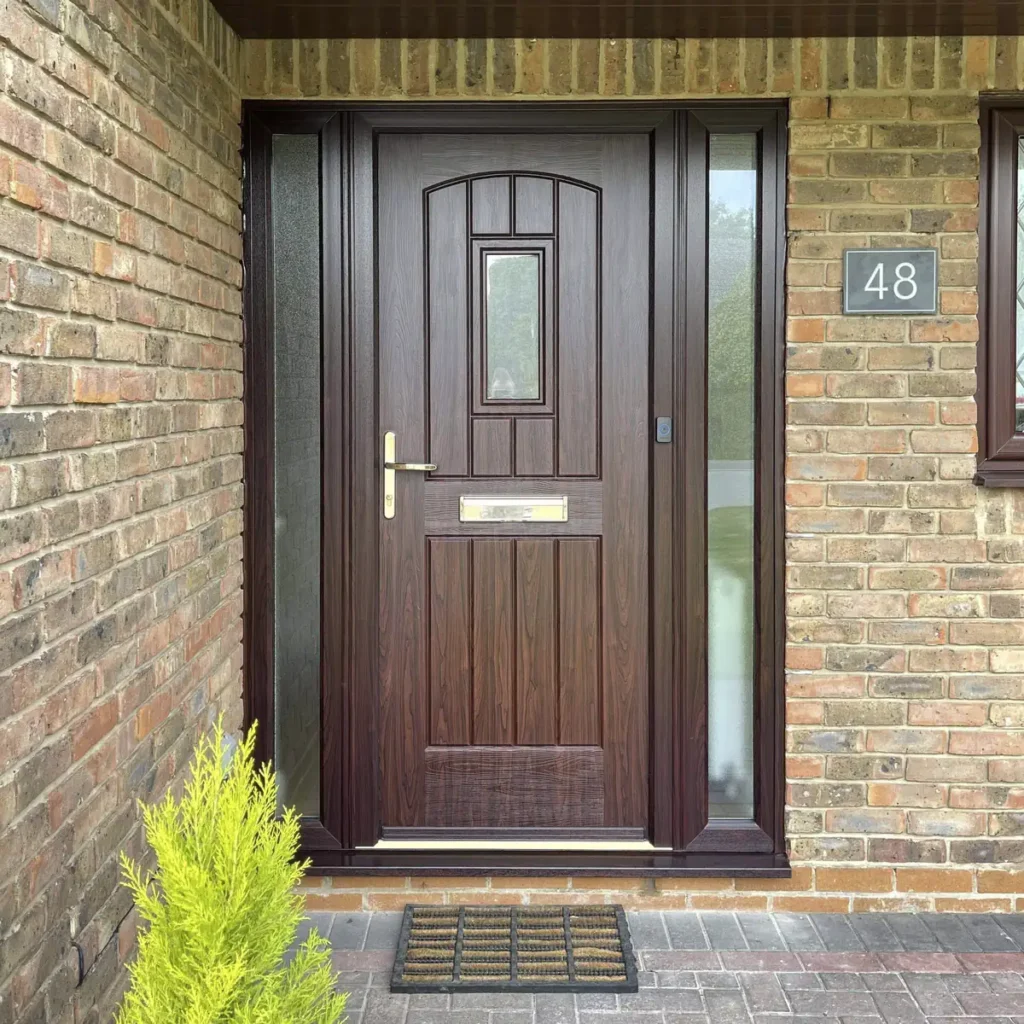
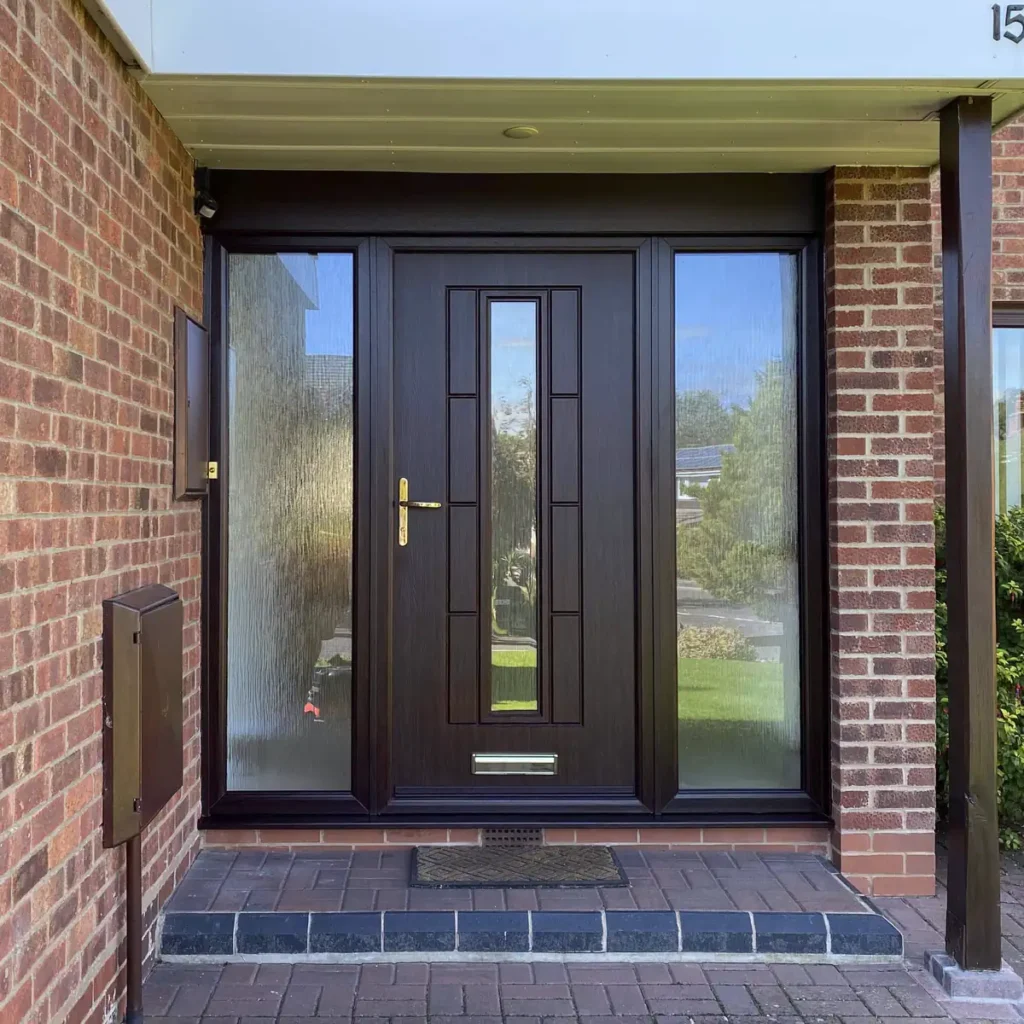
Rosewood is the deepest, richest woodgrain in the range — a dark mahogany-brown with a strong grain pattern. It was extremely popular during the 1990s and 2000s when rosewood window frames were the default upgrade from white uPVC, and many homes across the Midlands still have rosewood windows and fascias.
If your property already has rosewood windows, a rosewood Rockdoor is the obvious match. It creates continuity across the whole front of the house. However, if you’re starting from scratch with new windows and a new door, rosewood has fallen out of fashion in favour of the grey shades and Irish oak.
Best suited to: Properties with existing rosewood windows and fascias. Traditional homes where continuity with existing joinery is important.
Frame options: Matching rosewood frame available, or white.



Dual-Colour Doors: Different Inside and Out
One of Rockdoor’s most useful features is the ability to choose completely different colours for the inside and outside of your door slab. With 14 colours available on each face, that’s 196 possible combinations (14 × 14).
This means you can match the exterior to your brickwork and street-facing aesthetic while choosing a lighter or different colour for the interior to suit your hallway. The most common combination we fit is an exterior colour (usually agate grey, anthracite grey or Irish oak) with a white interior — keeping the hallway bright while the outside makes a statement.
Some customers go further. We’ve fitted anthracite grey outside with Irish oak inside, creating a contemporary exterior and a warm timber-feel interior. We’ve also done black outside with cream inside for a traditional Victorian look.
It’s worth noting that dual-colour only applies to the door slab itself — the frame and cill have their own colour rules. For the frame, the internal face can either match the external face or be white — you can’t mix two different colours. So if you choose an anthracite grey door with a white interior and an anthracite frame, you’d choose whether the internal frame face is also anthracite or white. Full details in the Frame Colour Options section below.
Frame Colour Options
Your frame colour matters as much as your door colour — it creates the border that ties the whole entrance together.
Eleven of the 14 Rockdoor colours are available as frame colours, and you can pair any available frame colour with any door colour. So if you want an Irish oak door with an anthracite grey frame, or an agate grey door with a black frame — you can. The three colours not available as a frame option are sapphire blue, ruby red and emerald green; if you choose one of those for your door, the frame will be white.
The frame has two faces — the external face (what you see from outside) and the internal face (what you see from your hallway). Your options for the internal face are:
- Same colour as the external face — for a fully colour-matched frame on both sides
- White — giving you a coloured frame on the outside and a clean white finish inside

Those are the only two options. You can’t have one colour externally and a different colour internally (other than white). For example, you can have an agate grey frame on both faces, or agate grey externally with white internally — but you can’t have agate grey externally with cream internally.
The one exception is pebble grey, where the internal frame face is always white. You can’t have pebble grey on both faces — it’s external only.
This is something to think about if you’re choosing a dark frame colour. A fully anthracite grey frame looks stunning from the outside, but it also means anthracite grey on the inside of your hallway. Most customers are happy with this, but if you’d prefer a lighter hallway, choosing a coloured external face with a white internal face gives you the best of both worlds.
When choosing a frame colour, think about your existing windows. If your windows are white uPVC (still the most common across the Midlands), a white frame with a coloured door creates a clean, traditional look. If your windows are anthracite grey, matching your door frame to the same colour creates that seamless, contemporary finish.
Some of our favourite combinations that customers have chosen:
- Irish oak door with anthracite grey frame and matching anthracite windows
- Agate grey door with white frame — clean and contemporary
- Black door with white frame — classic Victorian contrast
- Anthracite grey door with matching anthracite frame — fully coordinated modern look
The Rockdoor 3D door designer lets you try every door and frame colour combination on screen before you commit.
Cill Colour Options
The cill (the sill at the bottom of the door frame) is a separate component from the frame, and it has its own colour options. Over 95% of the Rockdoors we fit need a cill, so this is worth understanding.
The same 11 colours that are available for the frame are available for the cill: Agate Grey, Anthracite Grey, Slate Grey, Pebble Grey, White, Cream, Black, Chartwell Green, Irish Oak, Light Oak and Rosewood. And like the frame, the cill has an external face and an internal face with the same rules:
- Same colour on both faces — fully colour-matched inside and out (available for all colours except pebble grey)
- Colour externally, white internally — coloured on the outside, white on the inside (available for all colours)
- White on both faces — the standard option
You can’t have a white external face with a coloured internal face — it only works the other way round.
Most customers match their cill colour to their frame colour for a consistent look. If you’ve chosen an anthracite grey frame, an anthracite grey cill ties the whole entrance together neatly. But they are ordered separately, so you do have the flexibility to mix if you want to — for example, a coloured frame with a white cill is a perfectly valid choice.
Cill prices depend on the size and colour. Larger sidelights require a wider cill, and coloured cills cost more than white. We include all cill costs in our quotes upfront — see our composite door prices guide for typical costs.

How Rockdoor Colours Are Applied
Rockdoor colours aren’t painted on — they’re part of a uPVC skin that’s vacuum-formed onto an aluminium mould during manufacturing. The colour is infused directly into the material, creating a durable, grained finish with a depth and texture that closely resembles natural timber.
The woodgrain texture on a Rockdoor skin is one of the best in the composite door market. The foil’s woodgrain effect is estimated to be approximately 0.6mm deep — enough to genuinely feel and see the grain pattern, but not so deep that it looks artificial or overdone. It strikes the right balance between realism and subtlety, and it’s noticeably different to the flatter, shinier finish you get on a standard GRP composite door.

An installer detail that most people don’t know: every Rockdoor style has exactly the same woodgrain pattern, regardless of the colour you choose. The grain is designed using CAD software and CNC-machined into an aluminium plate, and every door skin is pressed from that same plate. So whether you choose agate grey, Irish oak or white, you’re getting identical grain depth and pattern — just in a different colour. It’s one of the reasons the finish is so consistent across the range.
The key advantages over painted finishes:
Durability — the colour is part of the skin, not a surface coating. It won’t chip, flake or peel.
UV resistance — the foil is engineered to resist fading from sunlight. After fitting Rockdoors since 2010, we’ve seen doors that are 10+ years old still looking as good as the day they were fitted.
Low maintenance — a wipe with warm soapy water is all that’s needed to keep the finish clean. No repainting, no sanding, no staining.
For full details on how a Rockdoor is constructed — including the aluminium inner frame, foam core, S-Glaze technology and locking systems — see our complete Rockdoor technical guide.
Discover seamless integration and enhanced experiences designed to elevate your daily life. Our innovations transcend traditional boundaries, creating a more interconnected and intuitive world for everyone.
Which Colours Show Dirt the Most?
This is something nobody talks about online, but it matters in the real world. Your front door lives outside 365 days a year, and some colours stay looking cleaner than others between washes.
You might assume lighter colours would show dirt more, and to some extent white and cream do show muddy splashback from rain hitting the ground near the door. But in practice, black and the darker colours are the worst offenders. Every white spec of dust, cobweb, dried rain mark and slug or snail trail shows up clearly against a dark background. If your door is under a porch light that attracts insects, a black or anthracite grey door will show the evidence more than a lighter one.
The mid-toned greys — agate grey in particular — tend to stay looking the cleanest for the longest. It’s dark enough that rain splashes don’t stand out, but light enough that dust and cobwebs don’t show either. It’s one of the practical reasons agate grey has become so popular, beyond just the aesthetics.
All Rockdoor colours clean up easily with warm soapy water and a soft cloth. We’d recommend giving your door a wipe down every month or two — it takes five minutes and keeps it looking fresh regardless of colour.
Choosing the Right Colour for Your Home
After fitting 2,000+ doors since 2010, here are the practical considerations we discuss with every customer:
Match your windows first. If you have white uPVC windows, most colours will work. If you have anthracite grey windows, an anthracite grey door and frame creates the best overall look. If you have rosewood windows, rosewood is the natural choice. Getting this match right makes the biggest visual difference.
Consider your brickwork. Warm-toned brick (red, buff, yellow) pairs well with agate grey, Irish oak, cream or Chartwell green. Cool-toned brick (grey, blue-grey) suits anthracite grey, slate grey or black. Mixed brick works with almost anything.
Think about your aspect. South-facing and south-west-facing doors get the most direct sunlight. Lighter colours (white, cream, agate grey, Chartwell green, light oak) absorb less heat, which is worth considering. Darker colours (anthracite grey, black, emerald green) work perfectly well — Rockdoor’s aluminium inner frame restricts thermal movement and they offer a 3mm no-bow guarantee — but lighter shades give you extra peace of mind.
Check the neighbourhood. Not because you need to follow the crowd, but because a colour that stands out positively against your specific street context will have more kerb appeal than one that clashes. We’ve seen agate grey doors look incredible on one street and slightly lost on another, simply because of the surrounding houses.
See it in person if possible. Colours look different on screen than they do in real life, and they change depending on the light. We can bring colour samples to your property during the survey so you can hold them against your brickwork in natural light. This takes five minutes and prevents the most common source of colour regret.
Does Colour Affect the Price?
White is the base colour included in every Rockdoor quote. Choosing any other colour adds approximately £70 to the cost of the door slab. This applies equally to all 13 non-white colours — there’s no premium for greys over woodgrains or classics.
The colour upgrade is one of the smaller costs in a typical Rockdoor order. For context, glass designs range from £60 to £275 depending on the style, and most customers spend between £1,900 and £2,100 on a single Rockdoor all-in. The full pricing breakdown is in our Rockdoor prices guide.
If your outerframe needs to match the door colour, there’s an additional charge for the coloured frame — this varies depending on whether you have sidelights or toplights alongside the door. We include all frame costs in our quotes upfront so there are no surprises.
Frequently Asked Questions
Rockdoor offers 14 colours: Agate Grey, Anthracite Grey, Slate Grey, Pebble Grey, White, Cream, Black, Chartwell Green, Sapphire Blue, Ruby Red, Emerald Green, Irish Oak, Light Oak and Rosewood. The most recent addition was Pebble Grey, launched in 2024.
As of 2026, agate grey (RAL 7038) is the most popular colour we fit — accounting for around 30% of our installations. Anthracite grey (RAL 7016) is a close second and was the industry favourite for many years. Between the four grey shades, they make up well over half of all doors we install.
Yes — on the door slab itself. Every Rockdoor can have a different colour on each face, giving you 196 possible combinations (14 × 14). The most popular combination is a coloured exterior with a white interior. The frame works differently — the internal face can either match the external face or be white, but you can’t have two different colours. Pebble grey frames are always white internally.
11 of the 14 colours are available as a frame colour: Agate Grey, Anthracite Grey, Slate Grey, Pebble Grey, White, Cream, Black, Chartwell Green, Irish Oak, Light Oak and Rosewood. Sapphire Blue, Ruby Red and Emerald Green are only available with a white frame. You can pair any available frame colour with any door colour — they don’t have to match. The same 11 colours are also available for cills.
Rockdoor Anthracite Grey is RAL 7016 — the same RAL code used across the window and door industry. If your existing windows are RAL 7016, a Rockdoor in anthracite grey will be an exact colour match.
Rockdoor Agate Grey is RAL 7038. It’s a lighter, warmer grey than anthracite (RAL 7016) and is increasingly popular for its softer, more contemporary appearance.
Rockdoor’s foiled uPVC finish is engineered to resist UV fading. We’ve been fitting Rockdoors since 2010 and have seen doors that are over a decade old with no noticeable colour change. The finish is significantly more durable than a painted surface.
No. The colour upgrade is the same price (approximately £70) regardless of which colour you choose. White is the base colour included in the standard Rockdoor price.
Lighter colours (white, cream, agate grey, light oak, Chartwell green, pebble grey) absorb less heat and are the most cautious choice for south-facing doors. Darker colours work well too — Rockdoor’s aluminium inner frame manages thermal movement effectively and they offer a 3mm no-bow guarantee — but if you want maximum peace of mind, lighter shades are the way to go.
Yes, and we’d recommend it. RAL codes make this straightforward: if your windows are RAL 7016, choose anthracite grey. If they’re RAL 9010, choose white. For woodgrain window finishes, the Irish oak, light oak and rosewood options provide a close match. We can bring samples to your property during the survey to check the match in natural light.
What to Do Next
If you’d like to explore Rockdoor colour options for your property, here’s what we’d suggest:
Try the door designer — our Rockdoor 3D door designer lets you choose any style, colour and glass combination and see it from every angle. You can even upload a photo of your home to see how different colours look on your actual property.
Get a free quote — contact us with the colour and style you’re interested in and we’ll provide a full quote within 24 hours. We cover Derby, Nottingham, Leicester, Burton upon Trent and the wider Midlands.
Read more about Rockdoor — our Rockdoor page covers pricing from £1,500 fitted, styles we install, and why we’ve chosen Rockdoor for over 2,000 installations. For the full technical breakdown of how a Rockdoor is built, see our complete Rockdoor construction and specification guide. For a side-by-side brand comparison, see our Rockdoor vs Solidor vs Endurance guide.
Jim and Josh are a father-and-son team running Very Secure Doors from Derbyshire. They’ve been fitting Rockdoors since 2010, are a Rockdoor Trusted Installer, and have fitted over 2,000 doors across the Midlands. All photos in this guide are doors they’ve fitted themselves — no stock images or manufacturer shots.